
August 10, 2026 · Finch
Why Per-Case Costing Is Hard, Why Most ASCs Skip It, and Why It Still Wins
Per-case cost lives across four systems on different clocks, which is why most surgery centers never build it. Here is what it takes, and how profit per OR-minute turns costing into better block scheduling.
- per-case costing
- ASC profitability
- OR scheduling
- block time
- supply cost
Ask any ASC administrator what a case costs and you will usually get one of two answers: a number that came from a spreadsheet built months ago, or an honest "it depends."
Both answers are correct. Neither is useful when you are deciding which cases to put on next month's schedule.
Per-case costing is the single highest-leverage number in a surgery center, and it is also the number most centers do not have. That is not a competence problem. It is a plumbing problem.
Why per-case costing is genuinely hard
A case cost is not one number sitting in one system. It is an assembly job across four sources that were never designed to talk to each other.
Supplies are priced somewhere else. Your EHR knows what was pulled. Your materials management or GPO system knows what it cost. Those two records are joined by item descriptions that drift constantly — the same suture is "ETHICON 8681H" in one system and "Suture Vicryl 3-0" in the other. Every rename breaks the join.
Implants arrive as paper. High-cost implants often show up on a vendor sheet after the case, not as a structured line in the record. Somebody has to key it in, and if nobody does, the most expensive case of the week looks cheap.
Labor is a time problem, not a payroll problem. Staff cost per case depends on how long the room was actually occupied — not scheduled duration, and not the surgeon's historical average. Wheels-in to wheels-out is in the record, but turning it into dollars requires a loaded rate per role per minute.
Revenue lands 30 to 90 days later. Charges are not payments. Until the EOB posts, contractual adjustments, bundling rules, and denials are unknown. A case that looked profitable at charge can turn negative at remittance.
Put those together and per-case costing requires you to reconcile four systems on different clocks, with joins that break quietly. The math is easy. The data engineering is not.
Why most ASCs skip it
Because the work is real and the payoff is deferred.
- It is manual, so it is monthly at best. A workbook that takes two days to rebuild gets rebuilt when someone has two days. That is rarely.
- The number arrives after it matters. By the time the March analysis is ready, the April block schedule is locked.
- Averages feel close enough. Total margin is visible and reassuring. Case-level variance stays hidden inside it, which is exactly where the money is.
- Ownership is split. Clinical owns duration, materials owns cost, billing owns revenue. Per-case profitability sits between all three, so it belongs to nobody.
- Nobody wants a fight over bad numbers. Present a per-surgeon margin built on a shaky join and the first ten minutes of the meeting are about methodology. That experience teaches teams not to try again.
None of these are arguments against costing. They are arguments against doing it by hand.
Why it is worth doing anyway
Because case-level cost changes decisions that center-level margin cannot.
With a real per-case cost you can answer questions that are otherwise guesswork:
- Which procedures actually contribute? Not which ones bill the most — which ones clear cost after supplies, implants, and room time.
- Where is preference card drift costing you? Cards diverge from real usage over years. That gap is invisible in aggregate spend and obvious per case.
- Which payer mix is worth the block? The same procedure at two contracts can be a good case and a bad case.
- What should you renegotiate? Vendor conversations go differently when you can show cost per case rather than annual spend.
Total margin tells you whether last month worked. Per-case cost tells you what to do next month.
The metric that turns costing into scheduling: profit per OR-minute
Here is where per-case costing stops being an accounting exercise.
Your scarcest asset is not revenue or even staff. It is OR-minutes. A room can only be occupied once, so the real question for every case on the schedule is not "is this profitable?" but "is this the most profitable use of this minute?"
That is what profit per OR-minute measures: contribution after case cost, divided by actual room time.
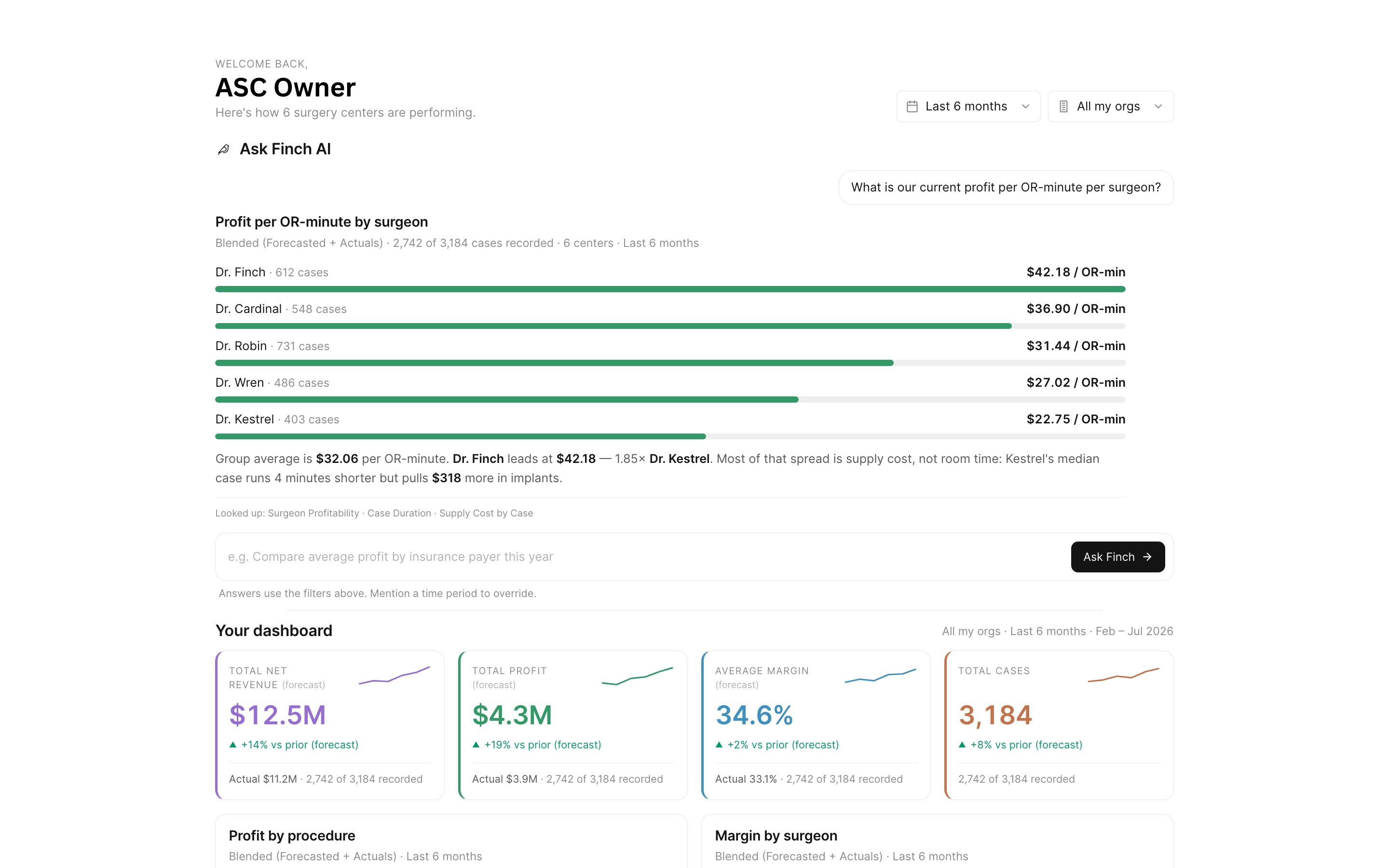
Profit per OR-minute by surgeon, blended forecast and actuals across six centers.
Read that spread carefully. The top surgeon returns $42.18 per OR-minute against a group average of $32.06 — about 1.85× the bottom of the list. The instinct is to assume the low performer is slow. In this case the opposite is true: their median case runs four minutes shorter, and they pull $318 more in implants. The gap is supply cost, not speed.
That distinction matters, because the two problems have opposite fixes. A duration problem is a scheduling and turnover conversation. A supply problem is a preference card and vendor conversation. Without cost at the case level, both look identical — "Dr. Kestrel is less profitable" — and you address the wrong one.
What changes in block scheduling
Once profit per OR-minute is visible, block allocation stops being a seniority and volume exercise:
- Give minutes to contribution, not to case count. A high-volume, low-contribution service line can consume the room that a shorter, higher-margin one needed.
- Fix cost before you cut time. If the spread is supplies, shaving turnover will not close it.
- Price the room honestly. When you know what a minute returns, you know what an add-on case, a late start, or an overrun actually costs.
- Make the case mix intentional. Two procedures with similar margins can differ sharply per minute, and the per-minute one is the one that scales.
Same schedule, same staff, different mix — measurably different contribution.
Where to start
You do not need a perfect model to get value. You need a repeatable one.
- Pick one specialty and one quarter. Narrow scope makes the joins tractable.
- Get supplies and implants to the case level first. That is where most of the variance lives.
- Use actual room time, not scheduled. Averages hide exactly what you are looking for.
- Reconcile at remittance. Compare forecast to actual once EOBs post, so the model earns trust.
- Then divide by minutes. Profit per OR-minute is the output that changes the schedule.
The centers that do this well are rarely the ones with the most analysts. They are the ones who stopped rebuilding the workbook and made case cost a standing output of the systems they already run.
If your team is still waiting on a monthly workbook to answer what a case made, the constraint is not effort. It is architecture — and it is fixable.
Schedule a walkthrough to see per-case costing and profit per OR-minute on your own data.